
Stellar Crown Bulbasaur vs Squirtle: Which IR Wins?

Bulbasaur and Squirtle are close enough in price to invite a lazy answer. Pick the one you like more, people say. Or buy Squirtle because it costs more. Or buy Bulbasaur because it costs less.
All three answers leave out the useful part: how much is the art premium, and what price makes that premium reasonable?
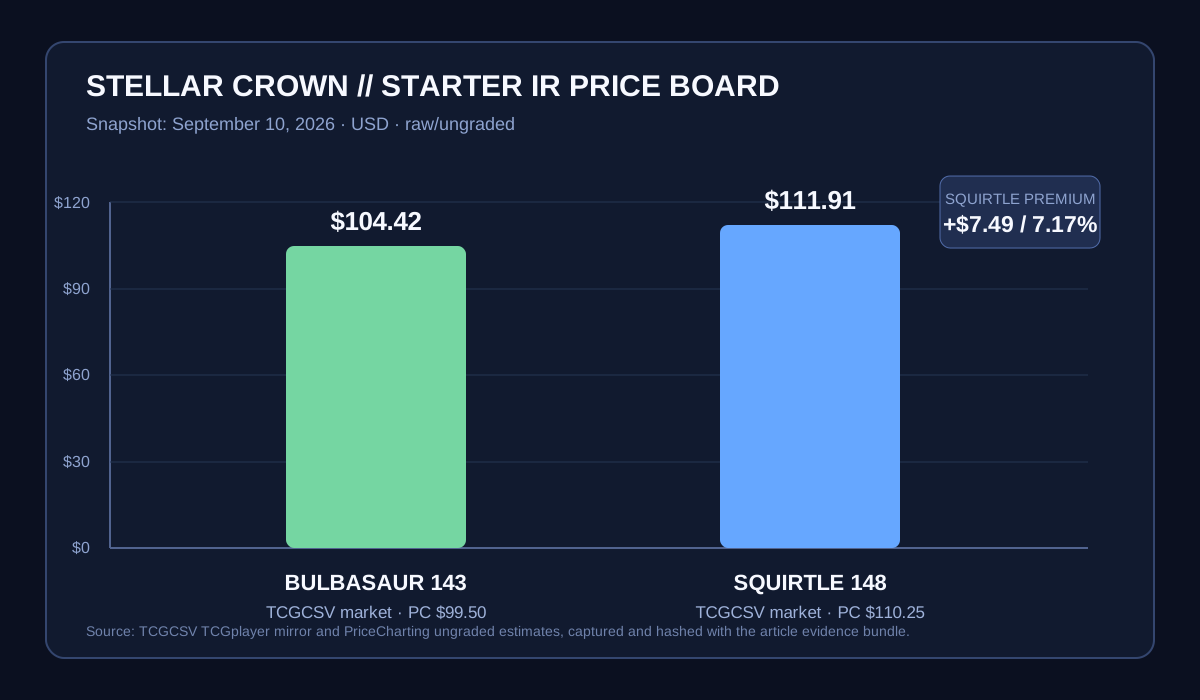
I pulled the current TCGCSV TCGplayer mirror, matched the product and price records by product ID, checked the card records against the PokémonTCG API, and compared both raw cards with an independent PriceCharting snapshot. On September 10, 2026, Bulbasaur 143 is at a $104.42 market price and Squirtle 148 is at $111.91.
That makes Squirtle $7.49 more expensive, a 7.17% premium over Bulbasaur. My call is Bulbasaur for the better raw value and Squirtle only when you prefer the art enough to pay for it. At the current numbers, neither one is a blind buy and neither one deserves a grading submission just because it is an Illustration Rare.
The fast buyer answer
Here are my subjective editorial zones informed by the September 10 snapshot, not validated fair-value boundaries. These are raw, ungraded cards. They are not promises about future prices, and they assume the copy is genuinely near mint rather than a played card hiding behind a flattering thumbnail.
| Card | Current market | Buy | Hold | Skip above |
|---|---|---|---|---|
| Bulbasaur 143 | $104.42 | $100 or less | $100.01–$120 | $120 |
| Squirtle 148 | $111.91 | $105 or less | $105.01–$130 | $130 |
If I can buy only one at today’s market: I take Bulbasaur. It costs $7.49 less and still gives me the original-151 character, an Illustration Rare treatment, and a card whose independent ungraded cross-check lands almost exactly on the $100 entry line.
If I am buying for the binder rather than the spreadsheet: Squirtle is perfectly defensible. The card has a different scene, a different illustrator, and a strong collector identity of its own. I just would not call the extra $7.49 a market bargain. It is a preference premium.
If a seller wants $140 for either card on September 10: I pass. That price is not supported by the current raw snapshot, and the extra money would be better kept available for a real market dislocation instead of being converted into FOMO.
The September 10 price snapshot
The numbers below come from the TCGCSV Stellar Crown product export and its matching price export. I joined the two files on productId, not on a fuzzy name search. That matters because “Bulbasaur” and “Squirtle” are not unique enough labels for a clean research workflow once multiple sets and finishes are in play.
| Card | TCGCSV product ID | Number in product data | Market | Low | Mid | Direct low |
|---|---|---|---|---|---|---|
| Bulbasaur | 567418 | 143/142 | $104.42 | $95.00 | $114.67 | $100.56 |
| Squirtle | 567429 | 148/142 | $111.91 | $99.00 | $119.88 | $124.09 |
The market field is the anchor I use for the comparison. The low field is useful for spotting a possible deal, but it is not a command to buy the cheapest listing without checking condition, language, seller history, and shipping. Bulbasaur’s $95 low is $9.42 below its market field. Squirtle’s $99 low is $12.91 below its market field. Those gaps are large enough to make a single low listing a poor substitute for the market baseline.
The mid field tells a different story again. Bulbasaur’s $114.67 mid is $10.25 above market, while Squirtle’s $119.88 mid is $7.97 above market. That is why I use a range rather than pretending one number is the “true” value. Market is a useful center. Low and mid describe the listings around it. None of them tells me that every copy changes hands at that exact price.
The dated CSV behind this table preserves the rows I used, and the chart below shows the same comparison without letting the two numbers blur together.
The cover uses the actual Squirtle 148 card art from the PokémonTCG image endpoint, not a generated scene or a fake product composite.
There is no dramatic market separation here. Squirtle leads, but it leads by a single-digit percentage. If the question is “which card is more expensive today?” the answer is Squirtle. If the question is “which card gives me more cardboard for my dollar?” the answer is Bulbasaur.
First, solve the 142 versus 175 confusion
A search for these cards produces two denominator conventions, and that can make a buyer think they are looking at different versions.
The TCGCSV product records identify Bulbasaur as 143/142 and Squirtle as 148/142, both Illustration Rares in group 23537. The PokémonTCG API records the set as Stellar Crown, part of the Scarlet & Violet series, released on September 13, 2024. Its set object reports a printedTotal of 142 and a full total of 175.
The official Bulbasaur card database page uses 143/175 in its indexed card information. The official Squirtle card database page uses 148/175. Those labels are not proof of a second Bulbasaur or Squirtle. They are different ways of displaying the same set’s printed portion and its complete numbered card count.
When I search a marketplace, I use four filters together:
- Stellar Crown or SV07.
- The exact card number, 143 for Bulbasaur or 148 for Squirtle.
- Illustration Rare, not the regular version of the Pokémon.
- English, raw, and near mint if that is what I am comparing.
If a listing says only “Stellar Crown Bulbasaur,” I have not verified enough to compare it with product 567418. If it says 143/175 instead of 143/142, I do not reject it automatically. I open the photos and confirm the card, finish, and condition. Numbering literacy is not glamorous, but buying the wrong version is a much more expensive mistake than missing a $5 dip.
Why Bulbasaur is the value pick
Bulbasaur wins the spreadsheet before the art conversation begins. The September 10 market gap is $7.49, and the TCGCSV low is $95.00. That gives a buyer more room to negotiate or wait for a clean copy under the $100 line.
The official card record lists Bulbasaur as a Basic Pokémon with 70 HP and Leech Seed, which does a small amount of damage and heals 20 damage from Bulbasaur. Those game details are not a price forecast. They are useful identification checks, and they remind me not to confuse the card’s printed play text with its collector thesis.
The collector thesis is simpler. Bulbasaur is one of the original starters, it has broad recognition outside the card game, and this Illustration Rare gives it a scene people can display rather than a plain character portrait. The official Stellar Crown art coverage credits Orca as the illustrator. That matters to the person buying the card for the image, even though no illustrator credit mechanically guarantees a price premium.
The independent cross-check is also friendly to the value case. The PriceCharting Bulbasaur page captured for this article shows an ungraded estimate of $99.50, $4.92 below the TCGCSV market figure. That does not mean the two sites are measuring identical transactions or were updated simultaneously. It does mean the preserved TCGCSV price is not wildly detached from the second snapshot.
My $100 buy line is a subjective editorial rule: it gives me a modest discount to the $104.42 market field and sits near the $99.50 independent estimate; it is not a mechanically validated fair-value boundary. At $95–$100 for a clean copy, I am buying the card. At $100.01–$120 inclusive, I am holding or waiting rather than chasing. Above $120, I skip under this article’s rule.
Why Squirtle can still be the right card
Squirtle is not an inferior Bulbasaur because it costs more. It is a different collector proposition.
The indexed official Squirtle card result identifies a Basic Pokémon with 60 HP, Withdraw, Skull Bash, and illustrator Saboteri; it does not state the Water type. The third-party PokémonTCG API record supplies Water as the type. I keep those sources separate: these details are for identification, not a claim that either card is a competitive staple. The official Stellar Crown art coverage places Bulbasaur and Squirtle in the same wider visual world with a Tiny Bird Pokémon. The two cards are companions in a set, not interchangeable copies of one design.
Squirtle’s current TCGCSV market price is $111.91, with a $99 low and a $119.88 mid. Its low is actually close to Bulbasaur’s market price, which is why a patient buyer can erase most of the premium by waiting for the right listing. I would pay up to $105 for a clean copy without needing a special reason. From $105.01 through $130 inclusive, I hold or wait under this subjective editorial rule; above $130, I skip. Those boundaries are not a forecast or a mechanically derived valuation.
The preserved PriceCharting Squirtle page shows $110.25 ungraded, $10.75 above its Bulbasaur estimate. The cross-source gap is wider than TCGCSV’s $7.49 gap, but the conclusion is unchanged. Squirtle is the more expensive card in both checks; the premium is not large enough to prove superior investment quality.
That distinction matters. A card can be the better personal purchase and the worse value purchase at the same time. If I want Squirtle’s art, the extra money buys the exact thing I wanted. If I am asking which card has the cleaner entry, I should not hide that premium inside a story about momentum.
What the grading numbers actually say
The raw market is not the graded market. The preserved PriceCharting Squirtle page and Bulbasaur page show ungraded estimates of $99.50 for Bulbasaur and $110.25 for Squirtle. Their PSA 10 estimates are $320.17 for Bulbasaur and $402.50 for Squirtle. These are values in the captured pages, not a claim that both providers updated at the same moment.
That creates a tempting headline: the PSA 10 multiple is about 3.22 times the Bulbasaur ungraded estimate and 3.65 times the Squirtle estimate. I do not read that as “send both cards to PSA.” A population of perfect-looking photos is not the same thing as a guaranteed gem-mint grade, and an estimate is not a net sale after grading, shipping, insurance, and selling friction.
There is an even more useful warning in the grade ladder. The preserved PriceCharting pages show Grade 9 estimates of $103.83 for Bulbasaur and $115.59 for Squirtle. The Grade 9 gap is $11.76, compared with an $82.33 PSA 10 gap. Grade 9 adds little to either ungraded estimate before costs. That makes grading a condition bet rather than a simple value-add.
My rule is straightforward:
- Buy raw for the binder if the front is clean, the corners are sharp, and the price is inside the raw zone.
- Consider grading only a genuinely strong PSA 10 candidate after inspecting centering, edges, surface, print lines, and the back under good light.
- Do not grade a card because the PSA 10 number looks exciting. The whole decision depends on the probability of reaching that grade and the costs around the submission.
For a deeper version of the fee and grade-risk math, use Pokemon Cards Worth Grading for Profit in 2026. This pair is a good example of why the raw buy decision and the graded speculation decision should be kept separate.
Liquidity does not break the tie
I also checked the ungraded activity summary on both PriceCharting pages. Each reports roughly one sale per day for the ungraded card. That is not a perfect liquidity measure, and it is not a promise that my copy will sell tomorrow. It is enough to reject a common shortcut: there is no obvious activity advantage here that lets me ignore the price gap.
If one card had a much deeper sales rate, I might accept a smaller margin because getting out would be easier. This snapshot does not give me that reason. The choice stays anchored to price, condition, and the art I actually want.
That is why I would photograph both cards carefully before listing and avoid vague titles such as “rare Bulbasaur” or “Squirtle card.” Use the set, number, rarity, language, and condition. The same filters that protect a buyer also make a seller’s listing easier to trust.
The site’s TCGplayer price-chart guide covers the difference between market price, low listings, recent sales, and chart movement. Apply that checklist here instead of treating one seller’s $95 or $99 listing as a guaranteed market reset.
How I built the buy, hold, and skip lines
The buy lines are subjective editorial rules, not fitted or backtested valuations. I chose the 0.96 and 0.94 factors as modest discounts, with a larger discount for Squirtle because it already carries a premium; the sources do not establish those factors. For Bulbasaur, $104.42 × 0.96 = $100.24 to the nearest cent, rounded down to a $100 ceiling. That puts the entry below market and close to the $99.50 preserved ungraded estimate.
For Squirtle, I applied a slightly wider 0.94 margin factor to the $111.91 market figure: $111.91 × 0.94 = $105.20, rounded down to a $105 ceiling.
The hold zones are not forecasts or validated liquidity signals. They are subjective editorial rules for this snapshot: Bulbasaur is held or waited on from $100.01 through $120 inclusive, and Squirtle from $105.01 through $130 inclusive. Above each ceiling, I skip as a new buyer; these are decision boundaries, not targets I expect the cards to reach.
There is no hidden valuation model behind the hold ceilings. The reproducible part is the entry math: market price multiplied by the stated margin factor, then rounded down to the nearest whole dollar. The $120 Bulbasaur and $130 Squirtle ceilings are my discretionary maximums for this dated comparison, informed by the market and mid fields but not calculated from them, and they are not backtested, forecast, or source-reported fair values. If you want a purely mechanical rule, use the buy ceilings and treat every higher price as a wait.
Use the zones like this:
- Bulbasaur at $98 with clear photos: buy. The price is below the $100 ceiling and the copy is near the independent estimate.
- Squirtle at $102 with clear photos: buy. The art premium has disappeared into the discount.
- Bulbasaur at $112: hold or wait. It is within the market’s range, but not a special entry.
- Squirtle at $118: hold or wait unless the copy is exceptional or the card is a must-have.
- Squirtle at $130: hold or wait; Squirtle above $130: skip. Bulbasaur above $120 is also a skip. I want a new data point before paying beyond either subjective ceiling from this snapshot.
Condition can move a copy between zones. A card with whitening, a surface scratch, or an off-center back is not a market-price copy just because the seller typed “NM.” Conversely, a well-photographed, clean card can deserve the top of a zone.
What if I want both?
At the September 10 market prices, one Bulbasaur plus one Squirtle costs $216.33 before shipping and any tax. That is above a $200 two-card budget. At my buy ceilings, the pair costs $205, which is still slightly above $200 but close enough that a small seller discount or one patient low listing can solve the gap.
With a strict $200 budget, I would buy one clean Bulbasaur under $100 and keep the remaining cash rather than force a mediocre second copy. If the collection goal is specifically the starter pair, I would set alerts at $100 for Bulbasaur and $105 for Squirtle, then wait. The pair is more satisfying when both cards are clean than when one purchase is a rushed compromise.
With $250 available for the pair, I would still avoid automatically spending the whole amount. A $100 Bulbasaur plus a $105 Squirtle leaves $45 for shipping, sleeves, a better condition upgrade, or the next opportunity. The market does not reward me for spending my entire card budget just because I brought it to the checkout page.
Frequently asked questions
Is Bulbasaur 143/142 the same card as Bulbasaur 143/175?
The evidence captured for this article identifies them as the same Stellar Crown Illustration Rare number displayed against two set totals. TCGCSV’s product metadata uses 143/142, while the official card database uses 143/175. Confirm the set, number, rarity, language, and photos before buying. Do not assume every listing with “Bulbasaur 143” is the right card.
Which one is the better investment?
Bulbasaur is my better raw value pick at the September 10 snapshot because it costs $7.49 less on TCGCSV and its $104.42 market figure is close to the $99.50 preserved ungraded estimate. Squirtle may be the better personal collectible if you prefer its scene and are happy to pay the premium. Neither snapshot proves a future winner.
Should I buy both cards now?
Not at any price. I would buy the pair only if Bulbasaur is at or below $100 and Squirtle is at or below $105, or if the copies are unusually clean and I am buying for a long-term personal collection. At $216.33 for the two current market figures, the pair is not a discount bundle.
Are these good grading candidates?
They can be, but Illustration Rare status is not enough. The cross-check shows a sharp difference between Grade 9 and PSA 10 estimates, which makes centering and surface condition matter. Buy raw first. Consider grading only when the actual copy looks capable of the top grade and the full submission math still works after costs.
Does the higher Squirtle price mean it has stronger demand?
It means Squirtle is priced higher in both the TCGCSV and PriceCharting snapshots I checked on September 10. It does not isolate the reason. Character popularity, art preference, supply, condition mix, and listing composition can all affect a market figure. Treat the premium as observed pricing, not proof of a permanent demand advantage.
The bottom line
Bulbasaur wins the value test. Squirtle wins only if you personally value Squirtle’s art enough to pay for the premium.
My September 10 raw zones are simple: Bulbasaur at $100 or less is a buy, $100.01–$120 is a hold-or-wait range, and above $120 is a skip. Squirtle at $105 or less is a buy, $105.01–$130 is a hold-or-wait range, and above $130 is a skip.
The useful result is not that one starter has magically beaten the other. The useful result is that the gap is measurable. Squirtle costs $7.49 more today. The official art and illustrator difference can make that premium worthwhile to a collector, but the market data does not force me to pay it. I would buy the card I want, at the price the evidence supports, and leave the rest of the chase to somebody else.
Prices and market fields in this article were captured September 10, 2026. Marketplace values move; verify the current listing, condition, and seller before buying.


